The WCRI score is an assessment by the WCI in phase 1 of the index. It is not a certification and not an independent third-party verification.
How the WCRI is organised
The WCRI separates the rulebook, the assessment and the publication. That keeps the index transparent and independent of any single participant.
Pillars, points scale, evidence rules, weighting and versions, documented publicly.
WCRI methodologyRun by the WCI: guidance, evidence review, scoring and four-eyes approval. Independent third-party verification follows in phase 2.
Assessment processApproved scores with WCRI ID, validity and status on worldcleanup.org.
WCRI RegisterEach listing carries a QR code that leads to its Responsibility Passport.
WCRI RegisterThe seven pillars
Each pillar is oriented on one core subject of ISO 26000 and translates it into a practical assessment dimension. Pillar scores are weighted; the weights shown are the profile for organisations (companies, NGOs and other organisations). Municipalities are assessed with the weighting profile “municipality”. The weighting used is named on each passport. See the framework →
Transparent decision-making, values, ethics, governance
ISO 26000: Organizational governanceWeight 18 %Protection, equality, fair treatment
ISO 26000: Human rightsWeight 14 %Safe conditions, diversity, fair wages
ISO 26000: Labour practicesWeight 11 %Resource protection, climate action, waste reduction
ISO 26000: The environmentWeight 22 %Anti-corruption, ethical behaviour, supplier responsibility
ISO 26000: Fair operating practicesWeight 8 %Product safety, data protection, transparency
ISO 26000: Consumer issuesWeight 5 %Community involvement, volunteering, education
ISO 26000: Community involvement and developmentWeight 22 %Example: Planet & Pixels
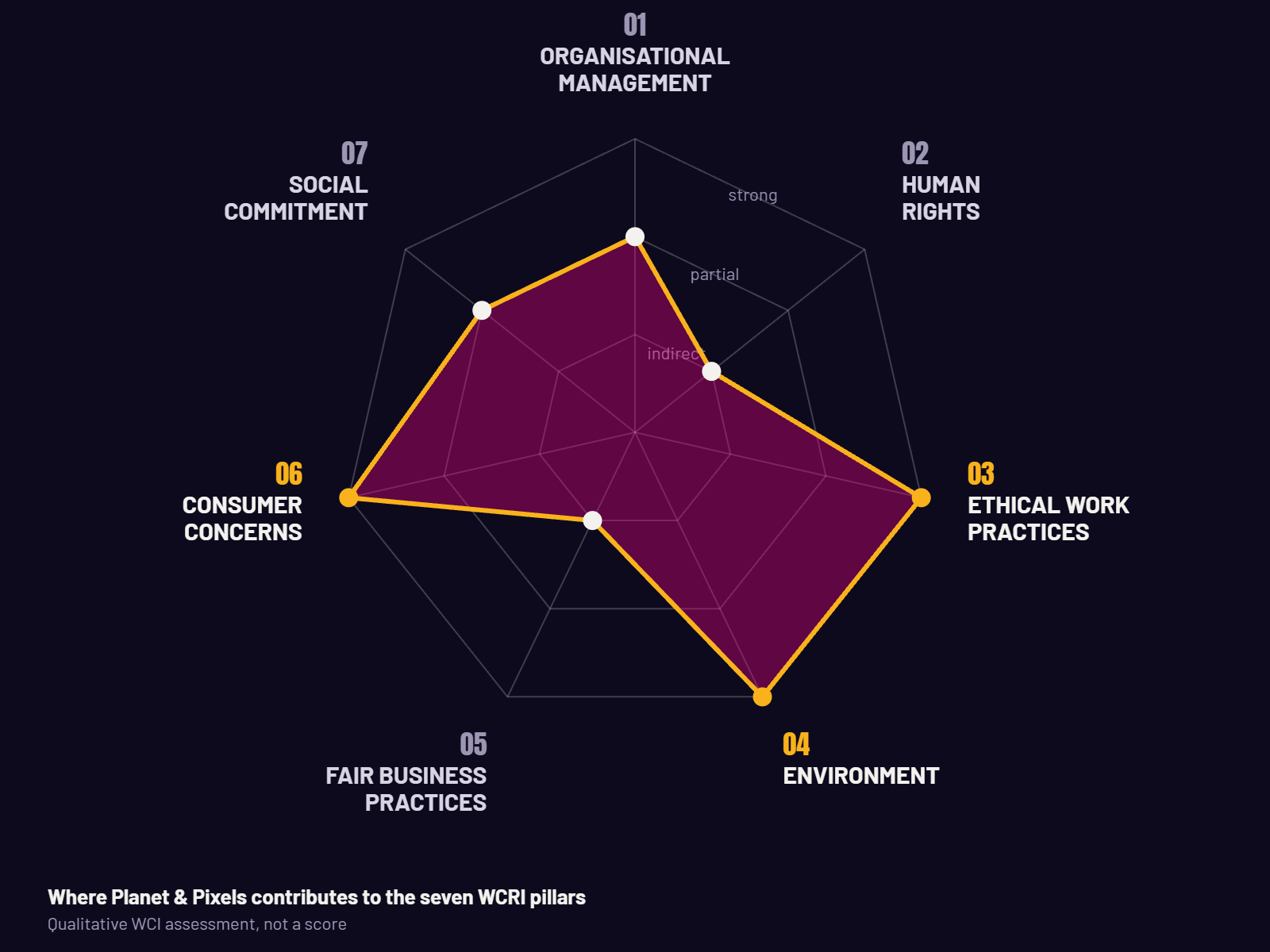
Digital Cleanup is part of the WCI Responsibility Framework. Planet & Pixels shows how it works in practice: the 15-day Pixel Break programme turns a one-off cleanup into a daily habit, and organisations can document the results as evidence, above all for pillars 03 Ethical work practices, 04 Environment and 06 Consumer concerns.
From application to listing
Ten steps in four phases, guided by WCI staff. The cycle repeats: scores are reviewed every year and fully re-assessed after 24 months.
Short expression of interest: background, motivation, purpose.
15-minute session on objectives, expectations and fit.
Current practice benchmarked against the seven pillars.
Detailed questionnaire and evidence documents.
Every answer checked against its cited source; statements without a documented source score zero.
A second WCI reviewer, not involved in the assessment, reviews and approves the result.
14 days for the organisation to comment and to object.
Publication on the WCRI Register with WCRI ID; QR code to the Responsibility Passport.
Updated figures and evidence; the listing is confirmed, corrected or suspended.
Full re-assessment after 24 months.
Badges: one record for organisations and people
The WCRI shows results as data, not as a seal. In phase 1 there are two badges: one for organisations and municipalities, one for individuals. The second opens the WCRI to lifelong learning.
Index badge
WCRI 1.11.15.68Score, segment, date and framework version, with a QR code to the register entry. A data display, not a mark: no emblem, no evaluative wording. Every assessed organisation receives it, also below 60.
Phase 1Engagement badge
- ActivityWorkshop · data culture
- Participation✓ confirmed
- Learning hours6 h
- Verified byBCBT · ERP
For students, volunteers and participants in cleanups, workshops and courses. It confirms participation and learning, carries no score and no assessment of the person, and stays with the learner. Personal data is processed only with consent.
Phase 1 · verified at the sourceResponsibility Seal
Not issued in phase 1
Only in phase 2, with a score of at least 60 and confirmation by an independent third party. Until then no seal, label or certified status is shown or offered.
Phase 2Verified where learning happens
The Berlin College of Business and Technology (BCBT) is introducing the verification of engagement badges in its new ERP: participation in courses, workshops and volunteering is confirmed where it is recorded. Partners who run cleanups or workshops can issue engagement badges the same way.
Badge illustrations show example values, not an assessed organisation or a real person.
Pilot participants · July–November 2026
Five organisations from business, retail, civil society and public administration test the WCRI in its pilot phase from July to November 2026. All five are listed in the WCRI Register with the status “In assessment”; scores are published there once the final assessment decision has been taken.

More
Company · packaging and household products. Pilot participant.
More
NGO · organiser of World Cleanup Day in Germany. Civil society pilot. The WCI director is president of Let’s Do It Germany e.V. and is not involved in this assessment.

More
Company · circular clothing. Pilot participant.
More
Public administration · Berlin district. Municipal pilot.

More
Shopping centre, Berlin. Pilot participant.
Governance
World Cleanup Institute for Entrepreneurship and Impact (WCI) at BCBT: methodology, assessment and publication.
Develops the index with practice partners.
Sets the methodology and the scoring model and decides on appeals at second instance; it does not assess individual cases (profiles): Prof. Dr. Anabel Ternès von Hattburg (WCI, internal member) · Marc Leberecht-Schneider · Daniela Felder.
Assessor and approver are two different people. Nobody who has worked for, advised or received sponsorship from the organisation in the past two years assesses or approves it. The WCI does not advise an organisation it assesses in the same cycle.
Each organisation may comment on its draft assessment for 14 days before publication. Appeals within 30 days are decided first by a WCI reviewer not involved in the assessment, then by the Advisory Board. Objections & complaints
Relationships between assessed organisations and WCI, BCBT, Let’s Do It Germany e.V. or World Cleanup Day are disclosed on each passport.
Listed organisations exchange experience and work together. WCRI Network
Apply for the next assessment round
Cities, NGOs, companies, academic institutions and community networks. Registering your interest is free and does not commit you to an assessment.